

In our analyses, we regularly examine current movements, identify possible influencing factors and assess the general market situation. However, these are not recommendations, but merely opinions and food for thought.
Find out more about Pretiorates.com
Pretiorates’ Thoughts – The Blue Pill for Wall Street
Over the past few weeks, we have been extremely cautious about the stock markets. Yet the S&P 500 seems largely unfazed by our skepticism: it continues to hover stubbornly near its all-time high. And this despite the fact that numerous investors—particularly those with exposure to the IT- & AI sector—have recently had to endure a veritable stock market bloodbath.
The fact that these massive corrections in many stocks have left barely a trace in the S&P 500 is primarily due to two factors:
While AI and other sectors took a serious hit, other segments of the index benefited from significant portfolio reallocations. Defensive stocks, in particular, were suddenly in demand again—safety over future prospects was the motto.
In light of spiraling government debt, more and more investors are trying to pull their capital out of government bonds and reallocate it to the private sector. This benefits not only corporate bonds but also stocks. It’s an intriguing topic that we’ll explore in greater detail in the not-too-distant future.
The following chart illustrates the percentage of stocks in the S&P 500 that are trading above their 50-day moving average. Over the past 60 days, this percentage temporarily plummeted to a dismal 20% before recently rebounding to over 65%—thereby providing a strong boost to the index. Normally, such a collapse in market breadth would trigger a noticeable index correction. This time? Lots of drama behind the scenes, but on the big stage, things remained surprisingly calm …
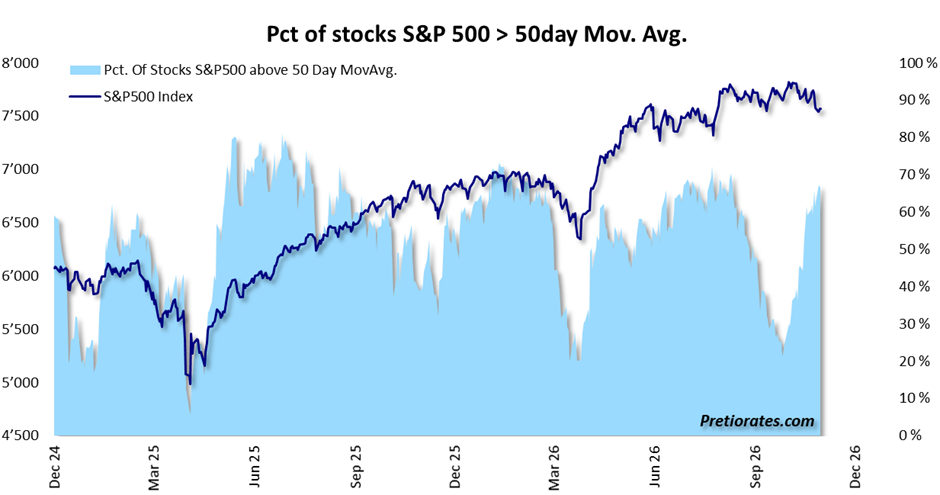
Still, 31.2% of all S&P 500 components are trading at least 20% below their respective 52-week highs. In other words: Nearly one in three stocks is in its very own bear market. So the bear has long been on the move—it’s just that hardly anyone in the index seems to have noticed it.
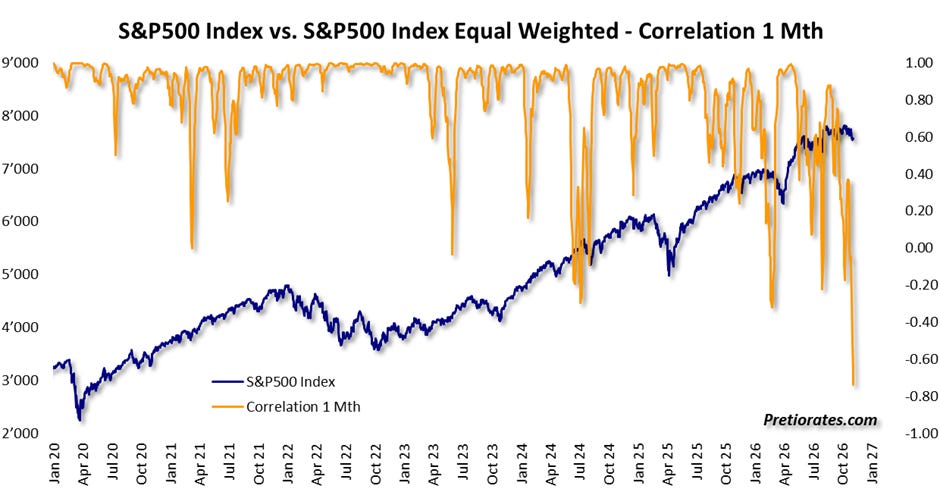
There’s a third reason why the S&P 500 is nevertheless basking in the vicinity of its all-time high: The index’s heavyweights have recently fared significantly better than the lightweights. The major sell-off took place primarily among the lower-weighted stocks. This trend is particularly striking when comparing the correlation between the classic S&P 500 and its equally-weighted “sister index,” in which all 500 companies are assigned the same weight. At times, this correlation plummeted to nearly −0.80! Mathematically, this means that the two indices moved in nearly opposite directions—even though they contain exactly the same stocks! The only difference lies in their weighting.
We also linked our expectation of a stock market correction to the assumption that the issue of “higher interest rates” would disappear from the agenda fairly quickly after a correction phase. In the extreme case of a more severe correction, a return to quantitative easing (QE) would even be conceivable. And that, of course, would be plenty of fuel for precious metals and cryptocurrencies.
The outcome of the U.S. midterm elections could now unexpectedly provide additional momentum for this expectation. A look at past midterm elections since 1951 reveals an interesting trend: Stocks have performed particularly well when the presidency and majorities in Congress were not entirely in the hands of the same party. So it seems the stock market definitely likes a divided government!
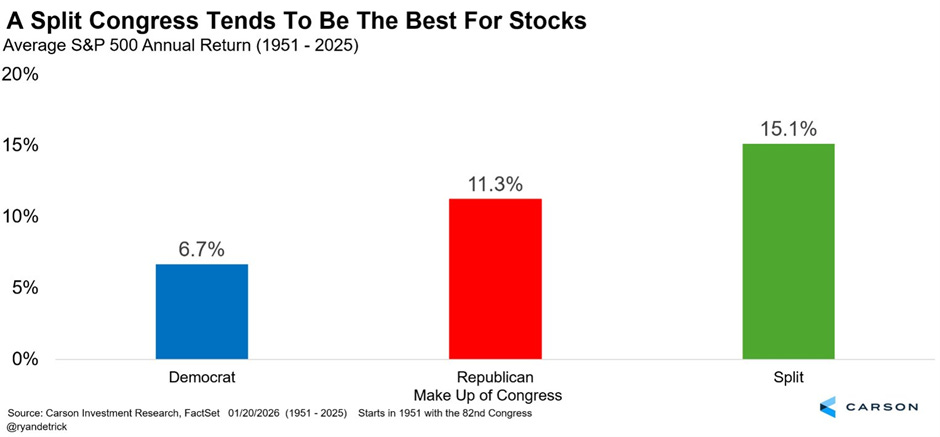
And that’s exactly the situation we have now! A surprisingly massive blue tsunami swept across the U.S., giving the Democrats a majority in both houses of Congress.
The financial markets didn’t take long to respond: Apparently, they expect that, given this political landscape, more liquidity will be pumped back into the system. The result? Stocks and precious metals literally skyrocketed, market yields plummeted, and the U.S. dollar took a hit. So the financial markets have already cast their vote—and quite unequivocally at that.
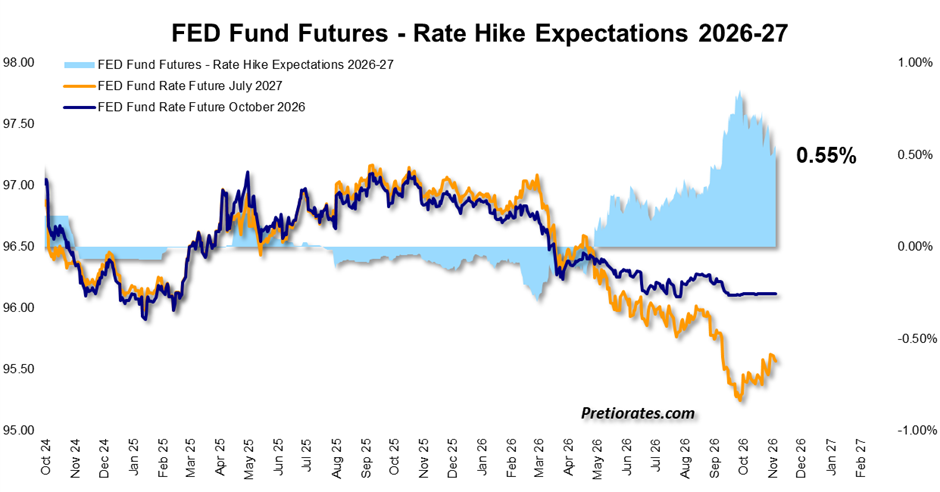
This trend was already evident in the bond futures market over the past few days, as the Democrats’ victory became increasingly likely. Expectations for further interest rate hikes have shrunk from around 0.75% to just 0.55% currently. That amounts to just over two rate hikes of one-quarter of a percentage point each. And don’t be surprised if even these remaining basis points continue to melt away!
This development naturally forces us to re-examine our previously cautious assessment of the stock markets. Today, the financial markets have delivered a very clear answer. Tomorrow, the initial euphoria is likely to subside somewhat. And then? Then the big “wish list” will likely begin, with expectations for the Democrats being raised a little higher with each passing day. This will also cause headaches and declines in the stock indices. So the next few days are likely to bring both good and bad days.
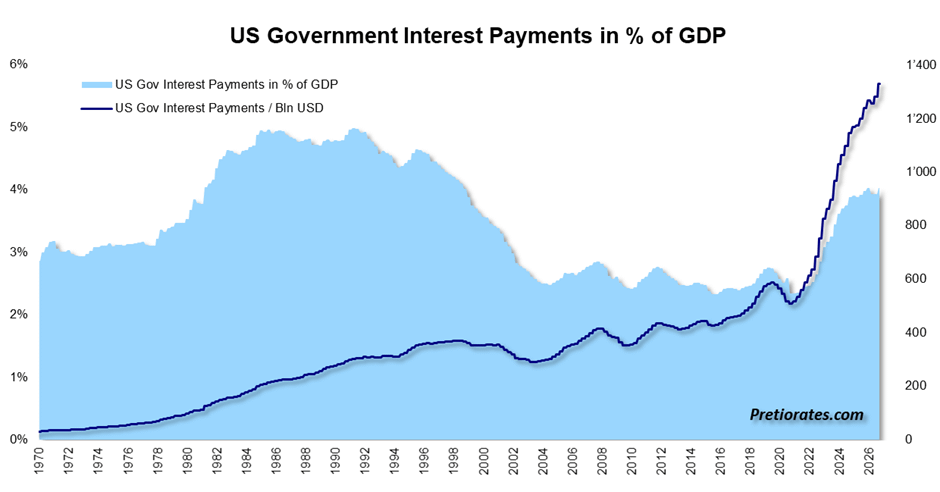
Because one thing must not be overlooked amid all the euphoria: The old problems have by no means disappeared. Measured against U.S. gross domestic product, interest payments on the massive mountain of debt continue to rise. So the debt party rages on—only the blue bill is getting steeper and steeper…
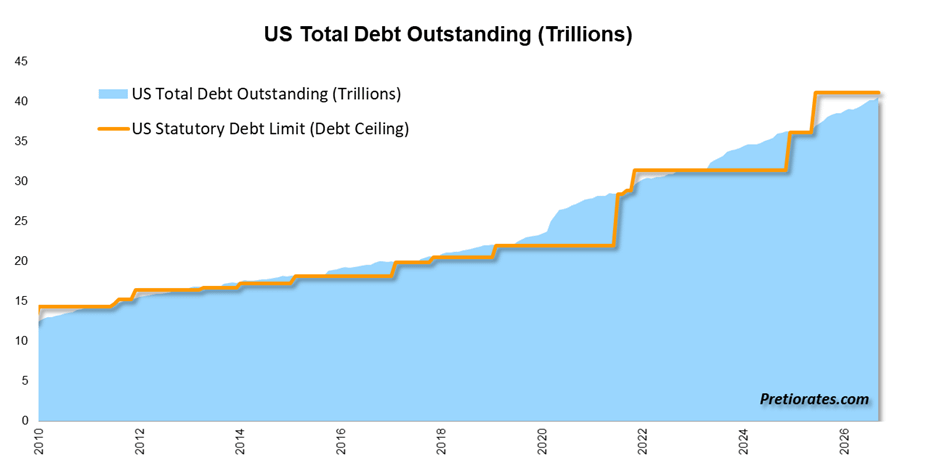
And as if that weren’t enough, U.S. national debt is already rapidly approaching its statutory debt ceiling once again. Consequently, this ceiling must be raised once more—which will likely happen. After all, raising the debt ceiling has almost become a routine political exercise in Washington…
The war with Iran is by no means over either and could create new uncertainties at any time. The geopolitical flashpoints thus continue to smolder. But as is well known, an additional dose of government liquidity can make it easier to digest many a problem in the financial markets. That is precisely why we must once again critically reexamine our previously negative assessment.
The intriguing question remains: Are stocks in the AI and data center sectors now worth buying again after the bloodbath of the past few weeks? The outcome of the U.S. elections certainly provides a fairly clear answer: These companies should actually be among the beneficiaries—even if the stock markets currently see things differently. After all, more liquidity also means more room for investment. But the truly interesting point lies elsewhere: Compared to the Republicans, the Democrats are more inclined toward regulation and oversight. And they’ll find the best tools in the AI sector to implement these measures! Ironically, the very call for more oversight could thus turn out to be an additional growth driver for the sector that has recently taken such a brutal beating.
We wish you successful investments!
If you enjoyed this issue, please click on the Like icon at the top or at the bottom of this email. This is very important in helping our Thoughts gain more followers. And don’t forget to recommend us - with the button below. Thank you!
Yours sincerely,
Pretiorates
Find out more about Pretiorates.com
Remember, we are not making any recommendations for investments, we are just giving you ideas for your own analysis and decisions! Do your own due dilligence!
If you like our short analysis, please recommend us to your friends!
Thank you for being a part of the Pretiorates community. Stay tuned for more updates, analyses, and deep dives into the realms of finance and economics.